Services
Videodermatoscopy
An advanced exam with high magnification, digital documentation, and safe comparison over time.

How does the exam work?
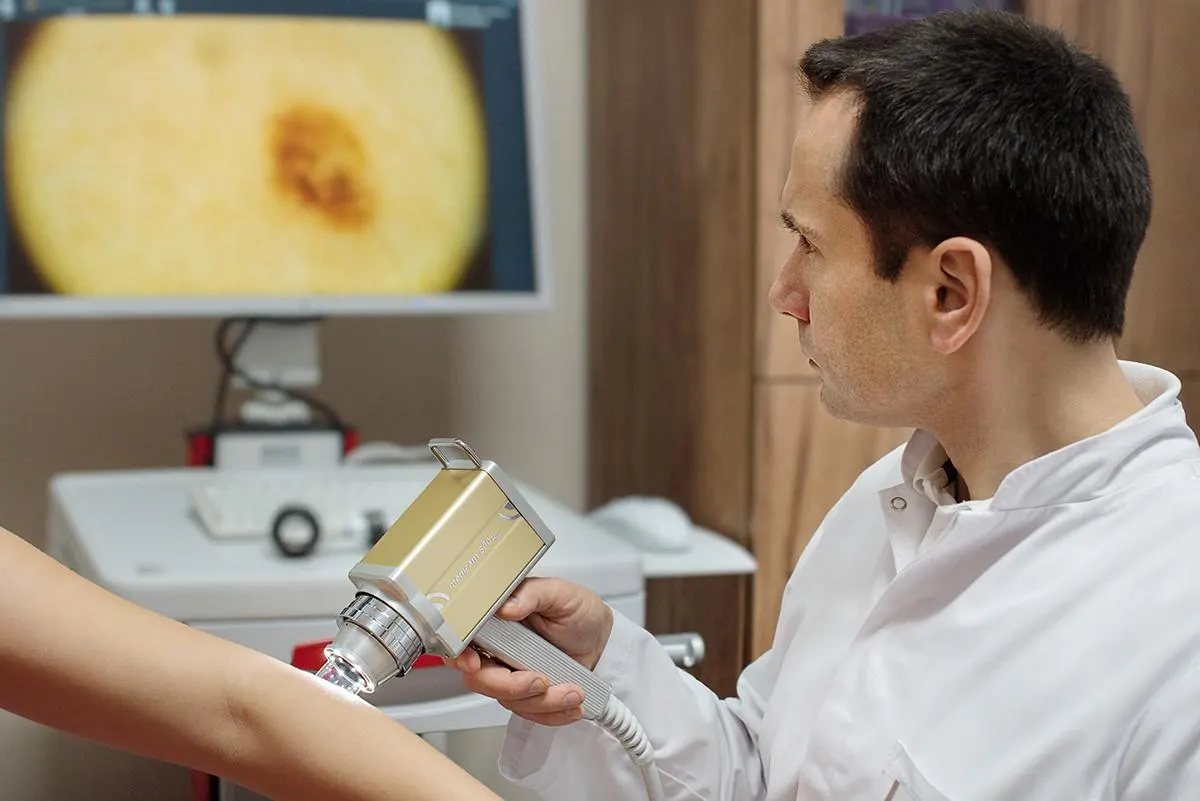
During a videodermatoscopy examination, the doctor places a special camera against selected lesions, producing an image magnified 20 to as much as 100 times. This reveals the internal structure of a mole that is invisible to the naked eye.
The images are stored in a database, and archiving them allows changes to be compared over time. We examine both adults and children.
Digital documentation supports safe follow‑up comparisons.
Who is videodermatoscopy for?
- Patients with multiple moles or new lesions.
- History of intense sun exposure or sunburns.
- Family history of skin cancer.
- Patients who need regular monitoring.
How should you prepare for the exam?
Please come to your videodermatoscopy appointment without makeup and with your hair tied back. It is also important not to apply creams or lotions to the skin, because during the examination the light from the dermatoscope must penetrate the skin and scatter within it. Powders, foundations, and creams prevent the light from penetrating and scattering, which makes the examination unreliable.
What to expect
We begin by taking your medical history.
The doctor performs a full-body videodermatoscopy examination and records any atypical lesions.
The doctor discusses the examination and advises on next steps, and issues a visit card. If a lesion is concerning and removal is recommended, you can book the surgical procedure straight away at the clinic reception.
Digital skin mapping supports monitoring
We combine full-body images with dermoscopy of selected lesions to track their dynamics over time.
- Side-by-side comparison at follow-up visits
- Documentation that supports clinical decisions
- Clear monitoring for higher-risk lesions

Common questions
Will I receive results immediately?
Yes, the doctor discusses findings and recommendations during the visit.
Does videodermatoscopy replace a consultation?
Videodermatoscopy is part of a specialist consultation and is performed by a doctor.